Evaluation of the mechanical propertiesof concrete with added shot blastingwaste
DOI:
https://doi.org/10.83179/txf6b648Keywords:
cement, sustainability, shot blasting dust, mechanical properties, durabilityAbstract
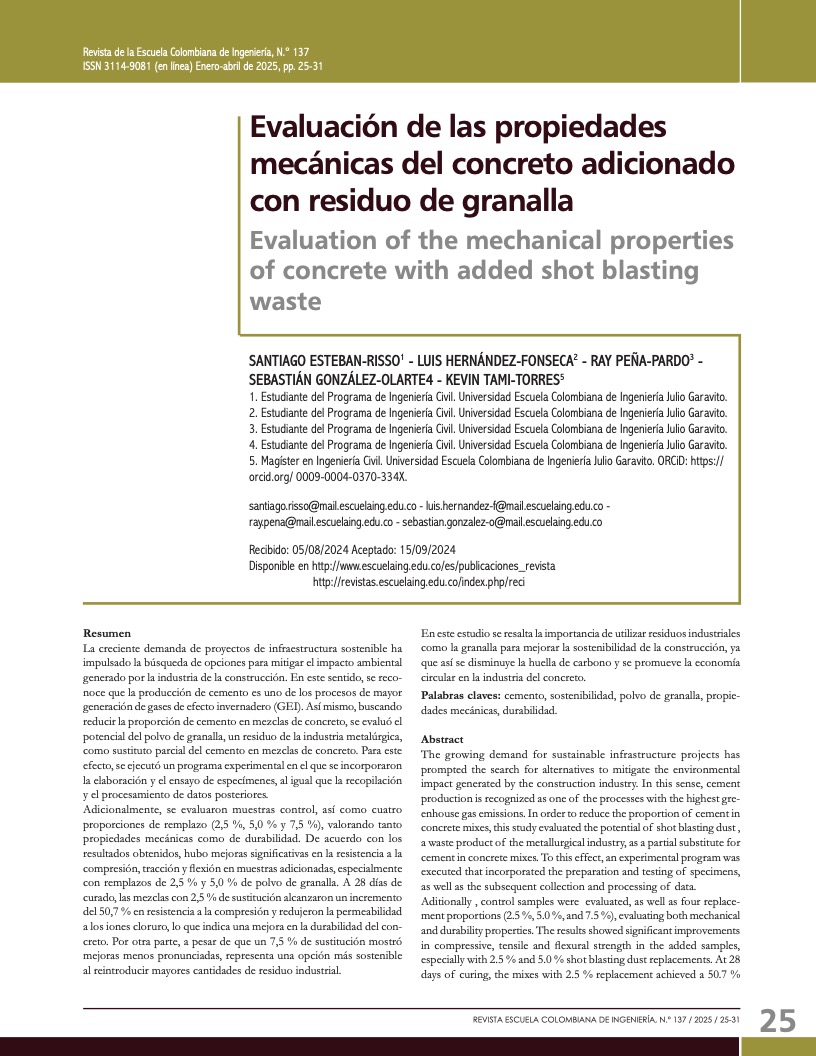
The growing demand for sustainable infrastructure projects has prompted the search for alternatives to mitigate the environmental impact generated by the construction industry. In this sense, cement production is recognized as one of the processes with the highest greenhouse gas emissions. In order to reduce the proportion of cement in concrete mixes, this study evaluated the potential of shot blasting dust, a waste product of the metallurgical industry, as a partial substitute for cement in concrete mixes. To this effect, an experimental program was executed that incorporated the preparation and testing of specimens, as well as the subsequent collection and processing of data. Additionally, control samples were evaluated, as well as four replacement proportions (2.5 %, 5.0%, and 7.5%), evaluating both mechanical and durability properties. The results showed significant improvements in compressive, tensile and flexural strength in the added samples, especially with 2.5% and 5.0% shot blasting dust replacements. At 28 days of curing, the mixes with 2.5% replacement achieved a 50.7% increase in compressive strength and reduced permeability to chloride ions, indicating an improvement in concrete durability. On the other hand, although 7.5% substitution showed less pronounced improvements, it represents a more sustainable option by reintroducing greater amounts of industrial waste. This study highlights the importance of using industrial waste such as shot blasting to improve the sustainability of construction, decreasing the carbon footprint and promoting the circular economy in the concrete industry.
Downloads
References
- Abrasivos y Maquinaria, S.A. (s.f.). Silicato de aluminio (arena para chorrear). http://www.abrasivosymaquinaria.com/silicato-dealuminio
- Andrew, R. M. (2018). Global CO2 emissions from cement production.
- Earth System Science Data, 10(1), 195-217. Benhelal, E., Zahedi, G., Shamsaei, E., & Bahadori, A. (2013).Global strategies and potentials to curb CO2 emissions in cement industry.
- Journal of Cleaner Production, 51, 142-161. Berridi, I. (2008). Análisis de la influencia de residuos metalúrgicos como áridos en las propiedades del hormigón. Universidad Politécnica de Cataluña.
- Environmental Protection Agency (2000). Guide to cleaner technologies: alternatives to chlorinated solvents for cleaning and degreasing0. EPA.
- European Commission (2001). Integrated Pollution Prevention and Control (IPPC). Reference document on best available techniques in the iron and steel industry.
- Muñoz-Pérez, S. P. (2022). Comportamiento físico-mecánico del hormigón adicionando residuos de acero: una revisión literaria. Revista UIS Ingenierías, 21(1), 57-72.
- Ramírez, D. E., y Vergara, M. F. (2013). Evaluación de la resistencia mecánica del concreto modificado con residuo de granalla de silicato de aluminio [tesis de pregrado en Ingeniería Química]. Universidad de Cartagena.
- Ramírez, N. (s.f.). Concepto para la disposición del residuo de granalla de silicato de aluminio.
- Serrano, M. F. (2011). Concreto preparado con residuos industriales: resultado de alianza empresa-universidad. Revista Educación en Ingeniería, 6(11), 1-11.
- World Steel Association (2021). Steel’s contribution to a low carbon future and climate resilient societies. WSA.
- Yellishetty, M., Ranjith, P. G., Tharumarajah, A., & Bhosale, S. (2010). Life cycle assessment in the minerals and metals sector: a critical review of selected issues and challenges. International Journal of Life Cycle Assessment, 15(8), 876-890.
Downloads
Published
Issue
Section
Categories