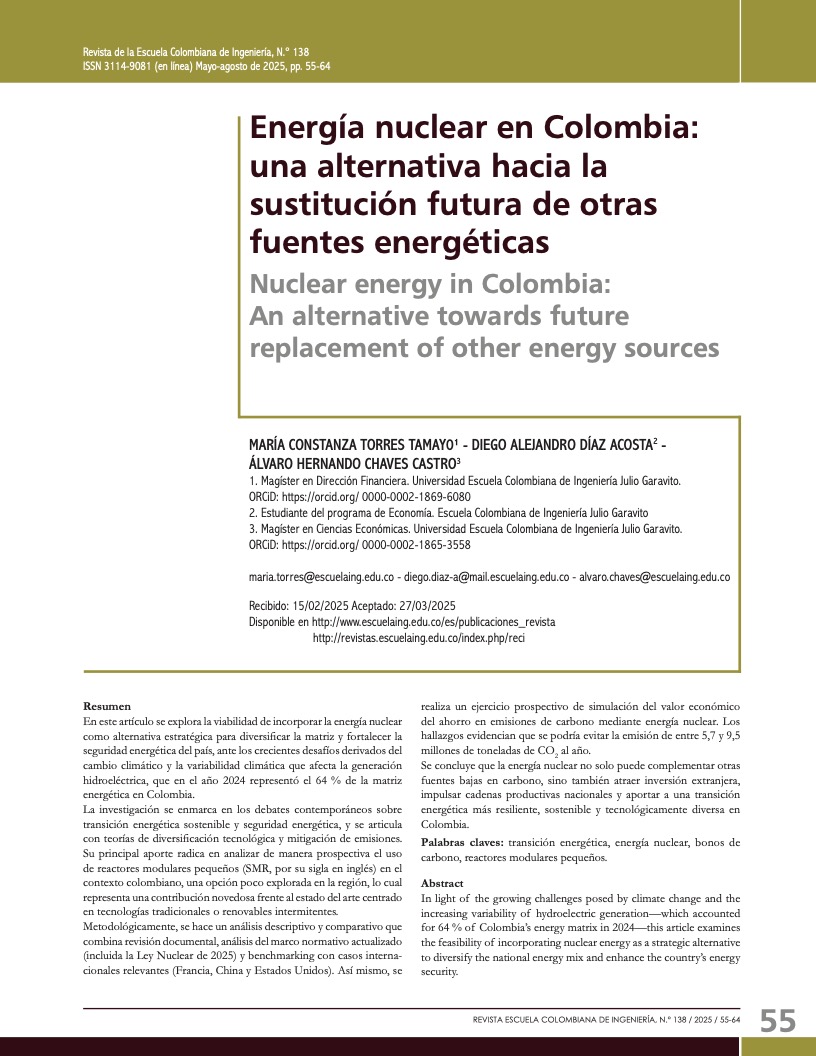
Nuclear energy in Colombia: An alternative towards future replacement of other energy sources
DOI:
https://doi.org/10.83179/6ssccb39Keywords:
energy transition, nuclear energy, carbon credits, small modular reactorsAbstract
In light of the growing challenges posed by climate change and the increasing variability of hydroelectric generation—which accounted for 64 % of Colombia’s energy matrix in 2024—this article examines the feasibility of incorporating nuclear energy as a strategic alternative to diversify the national energy mix and enhance the country’s energy security. The study is grounded in current debates on sustainable energy transitions and energy security, drawing upon theories of technological diversification and carbon emission mitigation. Its main contribution lies in the prospective analysis of small modular reactors (SMRs) within the Colombian context—an approach scarcely explored in the region—offering a novel perspective compared to the prevailing focus on conventional or intermittent renewable technologies. Methodologically, the research follows a descriptive and comparative design, combining literature review, analysis of the updated regulatory framework—including the 2025 Nuclear Law—and benchmarking against relevant international experiences (France, China, and the United States). In addition, a prospective simulation exercise estimates the economic value of carbon emission reductions achievable through nuclear deployment. The findings suggest that between 5.7 and 9.5 million tons of CO₂ emissions could be avoided annually. The study concludes that nuclear energy could not only complement other low-carbon sources, but also attract foreign direct investment, stimulate domestic supply chains, and contribute to a more resilient, sustainable, and technologically diverse energy transition in Colombia.
Downloads
References
- Asocarbono (2025). Informe del estado actual del mercado de carbono. https://asocarbono.org/wp-content/uploads/2025/09/Informe-del-Estado-Actual-del-Mercado-de-Carbono-.
- DeepL GmbH (2023). DeepL Translator [Software]. https://www.deepl.com/translator
- International Atomic Energy Agency (IAEA) (2023a). Nuclear power and the clean energy transition. IAEA.
- International Atomic Energy Agency (IAEA) (2023b). Nuclear Technology Review 2023. IAEA.
- International Atomic Energy Agency (IAEA) (2023c). Life cycle assessment of electricity generation systems. IAEA.
- International Atomic Energy Agency (IAEA) (2024). Advances in small modular reactor technology developments. IAEA.
- International Atomic Energy Agency (IAEA) (2025). Power Reactor Information System (PRIS) Database. IAEA.
- La República (2024a). COP29 llega a un acuerdo para ejecutar el comercio mundial de créditos de carbono. https://www.larepublica.co/globoeconomia/cop29-llega-a-un-acuerdo-para-ejecutar-el-comercio-mundial-de-creditos-de-carbono-4005723
- La República (2024b). Más de 2000 productores de café venden bonos de carbono. https://www.larepublica.co/empresas/mas-de-2-000-productores-de-cafe-venden-bonos-de-carbono-3716079
- La República (2024c). Bonos de carbono: solución y controversia. https://www.larepublica.co/especiales/bonos-sostenibles/bonos-de-carbono-solucion-y-controversia-3722164
- Ministerio de Ambiente y Desarrollo Sostenible (MinAmbiente) (2024). Contexto de mercados de carbono. https://www.minambiente.gov.co/mercados-de-carbono/contextomercados-de-carbono/
- Ministerio de Minas y Energía de Colombia (2022). Plan Energético Nacional 2022-2052. Gobierno de Colombia.
- Ministerio de Minas y Energía de Colombia (2025). Ley Nuclear: marco regulatorio para el uso pacífico de tecnologías nucleares. Gobierno de Colombia.
- Nuclear Energy Agency (NEA) (2023). The costs of decarbonisation: system costs with high shares of nuclear and renewables. OECD Publishing.
- OpenAI (2023). ChatGPT (Mar 14 version) [Large language model]. https://chat.openai.com/
- Organización for Economic Co-operation and Development (OECD) (2022). Economic impacts of nuclear energy development. OECD Publishing.
- International Renewable Energy Agency (Irena) (2023). Renewable power generation costs in 2023. Irena.
- Organización Latinoamericana de Energía (Olade) & International Atomic Energy Agency (IAEA) (2024). Perspectivas para la energía nuclear en América Latina y el Caribe. Olade.
- Unidad de Planeación Minero Energética (UPME) (2024). Informe Anual del Sector Eléctrico Colombiano 2024. Gobierno de Colombia.
- United Nations (UN) (2022). Sustainable Development Goals Report 2022. UN.
- xAI (2025). Grok (versión 4) [Inteligencia artificial generativa]. https://grok.x.ai
Downloads
Published
Issue
Section
Categories