Feasibility analysis to implement self-generation solutions in non-regulated users in Colombia
DOI:
https://doi.org/10.83179/n1rtvh79Keywords:
solar photovoltaic self-generation, non-regulated users, techno-economic model, energy transitionAbstract
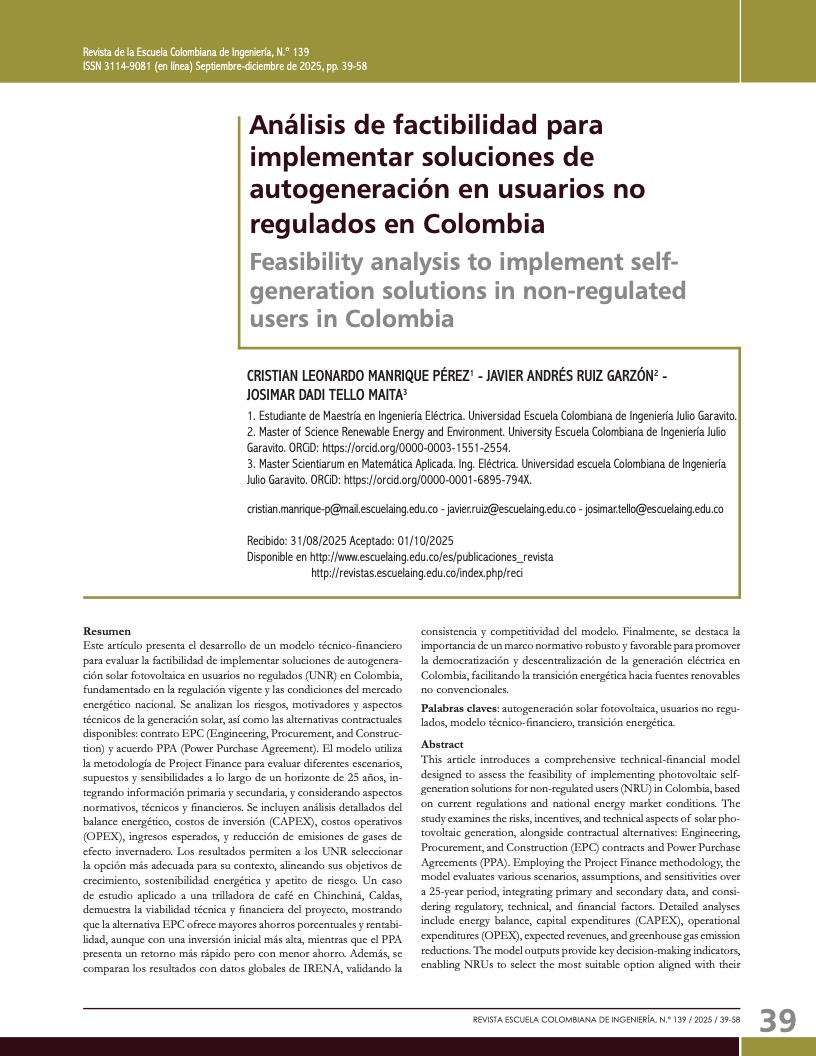
This article introduces a comprehensive technical-financial model designed to assess the feasibility of implementing photovoltaic self-generation solutions for non-regulated users (NRU) in Colombia, based on current regulations and national energy market conditions. The study examines the risks, incentives, and technical aspects of solar photovoltaic generation, alongside contractual alternatives: Engineering, Procurement, and Construction (EPC) contracts and Power Purchase Agreements (PPA). Employing the Project Finance methodology, the model evaluates various scenarios, assumptions, and sensitivities over a 25-year period, integrating primary and secondary data, and considering regulatory, technical, and financial factors. Detailed analyses include energy balance, capital expenditures (CAPEX), operational expenditures (OPEX), expected revenues, and greenhouse gas emission reductions. The model outputs provide key decision-making indicators, enabling NRUs to select the most suitable option aligned with their strategic growth, energy sustainability policies, and risk appetite. A case study involving a coffee milling facility in Chinchiná, Caldas, illustrates the technical and financial viability of the project, revealing that the EPC alternative yields higher percentage savings and profitability, albeit with a higher initial investment, while the PPA offers quicker returns but lower savings. Furthermore, the results are benchmarked against global data from the International Renewable Energy Agency (IRENA), confirming the model’s consistency and competitiveness. The study highlights the significance of a robust and favorable regulatory framework to promote the democratization and decentralization of electricity generation in Colombia, supporting the country’s energy transition towards non-conventional renewable energy sources.
Downloads
References
- Acuerdo 1726 de 2024 (2024). https://www.cno.org.co/content/acuerdo-1726-por-el-cual-se-aprueba-el-protocolo-para-la-aplicacion-de-la-metodologia-de
- International Renewable Energy Agency. (2022). Renewable power generation costs in 2021. https://www.irena.org/-/media/Files/IRENA/Agency/Publication/2022/Jul/IRENA_Power_Generation_Costs_2021.pdf
- Krüger, P., Landier, A., & Thesmar, D. (2015). The WACC Fallacy: The Real Effects of Using a Unique Discount Rate. The Journal of Finance, 70(3), 1253-1285. https://doi.org/10.1111/jofi.12250
- Mohamadi, F. (2021). Introduction to project finance in renewable energy infrastructure: Including public-private investments and non-mature markets. In Introduction to Project Finance in Renewable Energy Infrastructure: Including Public-Private Investments and Non-Mature Markets. Springer International Publishing. https://doi.org/10.1007/978-3-030-68740-3
- PVsyst SA. (2025). PVsyst Photovoltaic Software (8). https://www.pvsyst.com/es/
- Resolución CREG 011 de 2009, 1 (2009). https://gestornormativo.creg.gov.co/gestor/entorno/docs/resolucion_creg_0011_2009.htm
- Resolución CREG 024 de 2015, Pub. L. No. 024, 1 (2015). https://gestornormativo.creg.gov.co/gestor/entorno/docs/resolucion_creg_0024_2015.htm
- Resolución CREG 062 de 2000 (2000). https://gestornormativo.creg.gov.co/gestor/entorno/docs/resolucion_creg_0062_2000.htm
- Resolución CREG 080 de 2019, 1 (2019). https://gestornormativo.creg.gov.co/gestor/entorno/docs/resolucion_creg_0080_2019.htm
- Resolución CREG 119 de 2007, 1 (2007). https://gestornormativo.creg.gov.co/gestor/entorno/docs/resolucion_creg_0119_2007.htm
- Resolución CREG 135 de 2021 (2021). https://gestornormativo.creg.gov.co/gestor/entorno/docs/resolucion_creg_0135_2021.htm
- Resolución CREG 174 de 2021 (2021). https://gestornormativo.creg.gov.co/Publicac.nsf/1c09d18d2d5ffb5b05256eee00709c02/c99b2f316a59fffb052587590077d9d1/$FILE/Creg174-2021.pdf
- Ross, S., Westerfield, R., & Jaffe, J. (2012). Finanzas corporativas.
- Seguin, R., Woyak, J., Costyk, D., Hambrick, J., & Mather, B. (2016). High-Penetration PV Integration Handbook for Distribution Engineers. https://docs.nrel.gov/docs/fy16osti/63114.pdf
- Vélez, L. G. (2022, September 12). El alza en las tarifas de electricidad. https://luisguillermovelezalvarez.blogspot.com/2022/09/el-alza-en-las-tarifas-de-electricidad.html?m=1
- XM S.A. (2023a). Autogeneradores a Pequeña Escala. Sinergox. https://sinergox.xm.com.co/oferta/Paginas/Informes/AGPE.aspx
- XM S.A. (2023b). Demanda Comercial, Real y Pérdidas de Energía. Sinergox. https://sinergox.xm.com.co/dmnd/Paginas/Informes/DemandaRealPerdidas.aspx
- XM S.A. (2023c). Precio Promedio Ponderado de Bolsa. Sinergox. https://sinergox.xm.com.co/tpr/Paginas/Precios/preprocon
Downloads
Published
Issue
Section
Categories