Thematic Alignment between Scientific Publications in Engineering and Scopus: An Evaluation Based on Latent Dirichlet Allocation
DOI:
https://doi.org/10.83179/qkrcy925Keywords:
Latent Dirichlet Allocation, topic modeling, natural language processing, bibliometrics, scientific productionAbstract
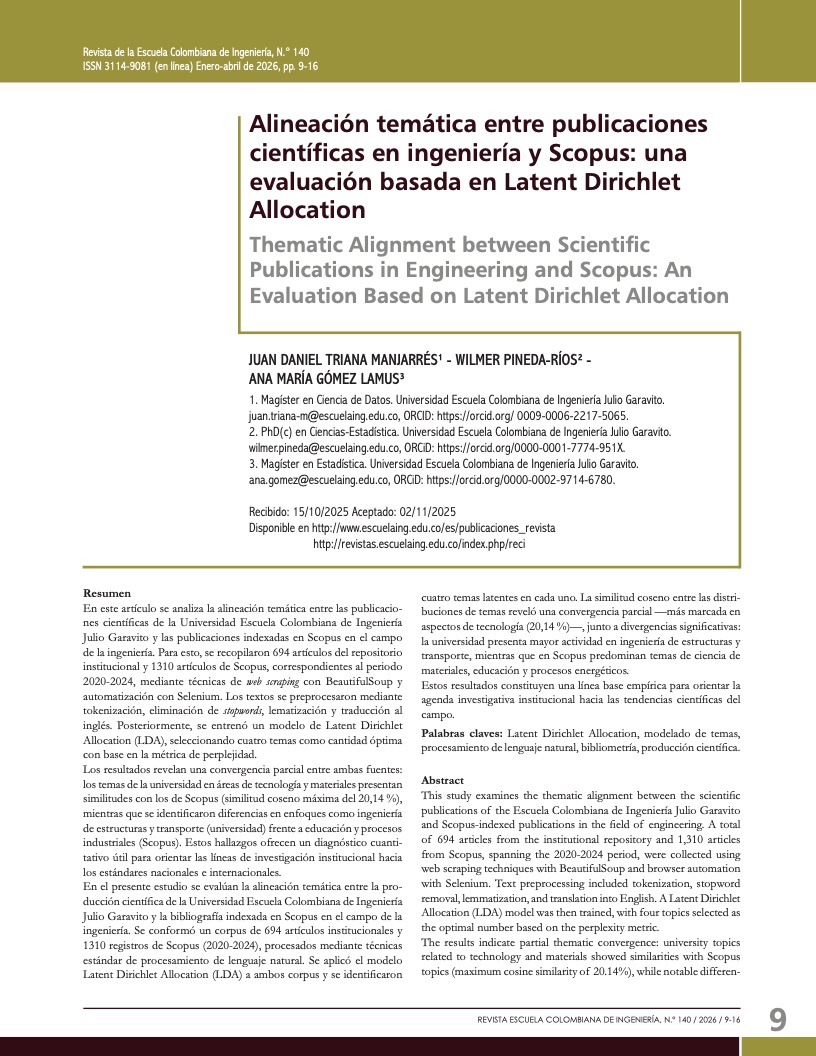
This study examines the thematic alignment between the scientific publications of the Escuela Colombiana de Ingeniería Julio Garavito and Scopus-indexed publications in the field of engineering. A total of 694 articles from the institutional repository and 1,310 articles from Scopus, spanning the 2020-2024 period, were collected using web scraping techniques with BeautifulSoup and browser automation with Selenium. Text preprocessing included tokenization, stopword removal, lemmatization, and translation into English. A Latent Dirichlet Allocation (LDA) model was then trained, with four topics selected as the optimal number based on the perplexity metric. The results indicate partial thematic convergence: university topics related to technology and materials showed similarities with Scopus topics (maximum cosine similarity of 20.14%), while notable differences emerged in areas such as structural engineering and transportation (university) versus education and industrial processes (Scopus). These findings provide a quantitative assessment that can guide institutional research priorities toward national and international standards. This study assesses the thematic alignment between the scientific output of the Escuela Colombiana de Ingeniería Julio Garavito and Scopus-indexed literature in the field of engineering. A corpus of 694 institutional articles and 1,310 Scopus records (2020-2024) was compiled and processed using standard natural language processing techniques. Latent Dirichlet Allocation (LDA) was applied to both corpora, identifying four latent topics in each. Cosine similarity between topic distributions revealed partial convergence — most notably in technology-related themes (20.14%) alongside significant divergences: the university shows greater activity in structural engineering and transportation, while Scopus is dominated by materials science, education, and energy processes. These results provide an empirical baseline for aligning the institutional research agenda with prevailing scientific trends in the field.
Downloads
References
- Ambalavanan, A. K., y Devarakonda, M. V. (2020). Using the contextual language model BERT for multi-criteria classification of scientific articles. Journal of Biomedical Informatics, 112, 103578. https://doi.org/10.1016/j.jbi.2020.103578
- Aria, M., y Cuccurullo, C. (2017). Bibliometrix: An R-tool for comprehensive science mapping analysis. Journal of Informetrics, 11(4), 959-975. https://doi.org/10.1016/j.joi.2017.08.007
- Asmussen, C. B., y Møller, C. (2019). Smart literature review: a practical topic modelling approach to exploratory literature review. Journal of Big Data, 6(1), 1-18. https://doi.org/10.1186/s40537-019-0255-7
- Blei, D. M., Ng, A. Y., y Jordan, M. I. (2003). Latent Dirichlet Allocation. Journal of Machine Learning Research, 3, 993-1022.
- Deerwester, S., Dumais, S. T., Furnas, G. W., Landauer, T. K., y Harshman, R. (1990). Indexing by latent semantic analysis. Journal of the American Society for Information Science, 41(6), 391-407. https://doi.org/10.1002/(SICI)1097-4571(199009)41:6<391::AID-ASI1>3.0.CO;2-9
- DiMaggio, P., Nag, M., y Blei, D. (2013). Exploiting affinities between topic modeling and the sociological perspective on culture: application to newspaper coverage of U.S. government arts funding. Poetics, 41(6), 570-606. https://doi.org/10.1016/j.poetic.2013.08.004
- Egger, R., Kroner, M., y Stöckl, A. (2022). Web scraping. En R. Egger (ed.), Applied data science in tourism (pp. 67-82). Springer. https://doi.org/10.1007/978-3-030-88389-8_5
- González, J. L., Castro, A. R., Mesa, M. L., y Maya, C. J. (2020). Producción científica en América Latina y el Caribe en el periodo 1996-2019. Revista Cubana de Medicina Militar, 49(4).
- Grisales Aguirre, C. J., y Figueroa Vallejo, A. M. (2022). Modelado de temas aplicado al análisis del papel del aprendizaje automático en revisiones sistemáticas. Revista de Investigación, Desarrollo e Innovación, 12(2).
- Hofmann, T. (1999). Probabilistic latent semantic indexing. En Proceedings of the 22nd Annual International ACM SIGIR Conference on Research and Development in Information Retrieval (pp. 50-57). ACM. https://doi.org/10.1145/312624.312649
- Jelodar, H., Wang, Y., Yuan, C., Feng, X., Jiang, X., Li, Y., y Zhao, L. (2017). Latent Dirichlet Allocation (LDA) and topic modeling: models, applications, a survey. Multimedia Tools and Applications, 78, 15169-15211. https://doi.org/10.1007/s11042-018-6894-4
- Kozlowski, D., Semeshenko, V., y Molinari, A. (2021). Latent Dirichlet Allocation model for world trade analysis. PLOS ONE, 16(2), e0245393. https://doi.org/10.1371/journal.pone.0245393
- Marroquín Arreola, J., y Ríos Bolívar, H. (2012). Inversión en investigación y crecimiento económico: un análisis empírico desde la perspectiva de los modelos de I+D. Investigación Económica, LXXI(282), 15-33.
- Nigam, H., y Biswas, P. (2021). Web scraping: from tools to related legislation and implementation using Python. En J. S. Raj, A. M. Iliyasu, R. Bestak y Z. A. Baig (eds.), Innovative Data Communication Technologies and Application (pp. 149-164). Springer. https://doi.org/10.1007/978-981-15-9651-3_14
- Oyewole, A. T., Adeoye, O. B., Addy, W. A., Okoye, C. C., Ofodile, O. C., y Ugochukwu, C. E. (2024). Automating financial reporting with natural language processing: a review and case analysis. World Journal of Advanced Research and Reviews, 21(03), 575-589. https://doi.org/10.30574/wjarr.2024.21.3.0700
- Rubiano, M. A. (2022). Análisis de temas utilizando Twitter: una aplicación del modelo LDA al caso colombiano [trabajo de grado]. Universidad Santo Tomás.
- Universidad Javeriana (2022). Inversión en Investigación y Desarrollo (I+D): evidencia a través de las patentes. Laboratorio de Economía de la Educación.
- Wasserman, M. (2000). Sobre la importancia de investigar en Colombia, un país subdesarrollado. Diálogos Globales de la Exposición.
Downloads
Published
Issue
Section
Categories